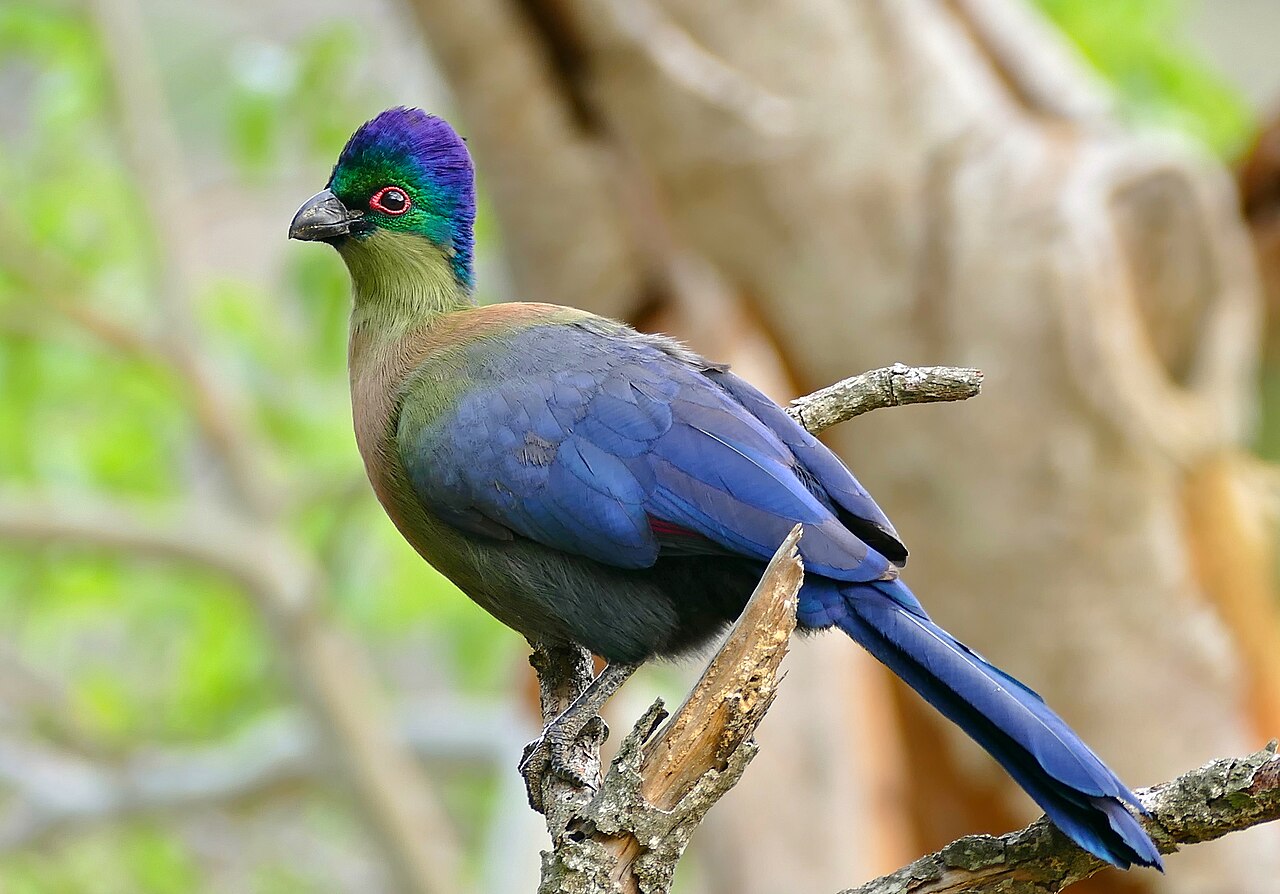
This order includes 23 species of colorful birds known as turacos, plantain-eaters, and go-away-birds. They are found only in sub-Saharan Africa, where they live in forests, woodlands, savannas, and other habitats with trees and dense shrubs.
Most species spend much of their time in the treetops, using their strong feet and long tails to climb and hop from branch to branch. Although they can fly well, they usually prefer to move through the trees rather than make long flights.
Musophagiformes birds eat mostly fruit, but they also feed on leaves, flowers, buds, seeds, and insects. Their fruit-rich diet helps spread seeds, making them important to the ecosystems where they live.
During the breeding season, a male and female work together to build a simple platform nest of sticks in a tree. The female usually lays two white eggs, and both parents take turns incubating the eggs and feeding the chicks after they hatch. The chicks are born with small claws on their wings, which help them climb through branches before they can fly.
These birds are known for their loud calls and social behavior. Some species live alone or in pairs, while others gather in small family groups.
Turacos are especially famous for their bright green, blue, purple, and red feathers. Unlike most birds, their green and red colors come from unique pigments called turacoverdin (green) and turacin (red), rather than from the microscopic structure of the feathers.
These birds were once classified in the Cuculiformes order with cuckoos. However, studies of their DNA, along with differences in their anatomy and behavior, showed that they are distinct enough to be placed in their own order, Musophagiformes.
FAMILIES
Musophagidae (turacos, plantain-eaters, go-away-birds)