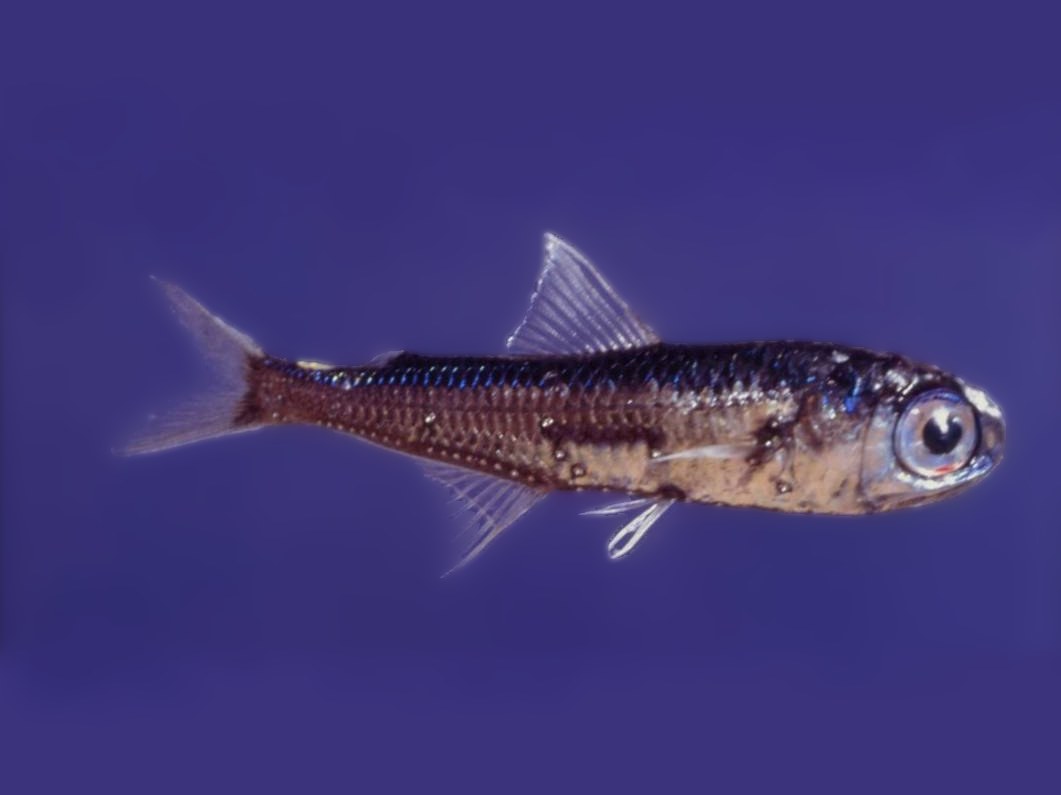
There are two families in this order of small, deep-sea fish. The Myctophidae family includes about 252 species of lanternfish, while the Neoscopelidae, or blackchin family, includes six species.
Lanternfish are typically small, growing between 2 and 6 inches (5.1-15.2 cm) long. They have slender, silvery bodies, large mouths, and big eyes that help them see in the dark depths of the ocean.
Their most distinctive feature is their ability to produce light, a trait called bioluminescence. They have tiny light-producing organs called photophores along their bodies. These lights help them camouflage from predators below, communicate with other fish, and attract prey.
Myctophiformes live in oceans around the world, mostly in deep water. During the day, they remain in dark, deeper layers of the ocean. At night, they swim closer to the surface to feed. This daily movement is called vertical migration. Vertical migration plays an important role in Earth’s climate by helping move carbon from surface waters to deeper layers.
They mainly eat tiny drifting animals called zooplankton, such as small crustaceans, and they are an important food source for larger fish, whales, and seabirds.
There are billions upon billions of lanternfish in the ocean—so many that scientists believe they may be the most numerous fish in the world.
Blackchin fish are found in tropical and subtropical oceans worldwide. They look very similar to lanternfish, but their anal fin is positioned far behind the dorsal fin. Some species also lack the light-emitting organs (photophores) found in lanternfish.