The long-tailed weasel has a long, slender body that is 1-2 feet (0.3-0.61 m) long, including its 3-6 inches (80-150 mm) tail. It weighs 3 to 9 ounces (85–267 g).
It has a small head with long whiskers, a long neck, and short legs. Its tail has a black tip. It has brown fur on the upper part of its body and white to yellow fur on its underside.
In the northern parts of its range, it turns white in the winter. Long-tailed weasels in the Southwest have a white mask.
Habitat
The long-tailed weasel lives in a wide variety of habitats, including woodlands, thickets, open areas, and farmland. It usually lives near a water source.
Diet
The long-tailed weasel is a carnivore. It has a very high rate of metabolism and eats about 40% of its body weight every day. Most of its diet is made up of small mammals like mice, voles, rabbits, gophers, and chipmunks. It occasionally eats birds and insects.
It crushes its prey’s skull with its canine teeth. It uses scent and sound to track its prey. Its long, thin body makes it easy for it to follow prey into burrows.
Life Cycle
The long-tailed weasel mates in the summer, but the fertilized eggs don’t begin to develop until about 27 days before the babies are born. The female gives birth in the spring. Most litters have 4-8 young.
The weasel kits are born blind and have a light covering of fur. Their eyes open, and they are weaned when they are about 36 days old. The female brings them food when they are weaned and later takes them hunting. The weasel kits leave their mother when they are 7-8 weeks old.
In the wild, the long-tailed weasel has a lifespan of 5-7 years. It can live to be 8 years old in captivity.
Behavior
The long-tailed weasel is a solitary animal, except during mating season. It lives in the abandoned burrows of other mammals, in rotting logs, or under tree roots or rocks. Its nest is made of grass and leaves and lined with fur.
The long-tailed weasel is most active at night, but it also comes out during the day. It does not hibernate. The long-tailed weasel can climb trees, and it is a good swimmer.
It uses lots of different vocalizations, including squeals, squeaks, trills, and purrs. It is very aggressive when its territory is invaded.
Did You Know?
The long-tailed weasel releases a strong-smelling musk during mating season and when it is frightened.
Support for NatureWorks is provided by:
The Long-Tailed Weasel in NH
The long-tailed weasel is found across New Hampshire, usually in wooded or rocky areas near water.
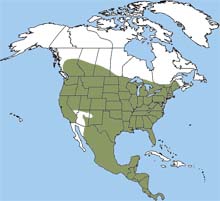
The long-tailed weasel is found in most of the United States, except for parts of southeast California and Nevada and most of Arizona. It is also found in Canada, Mexico, and Central and South America.