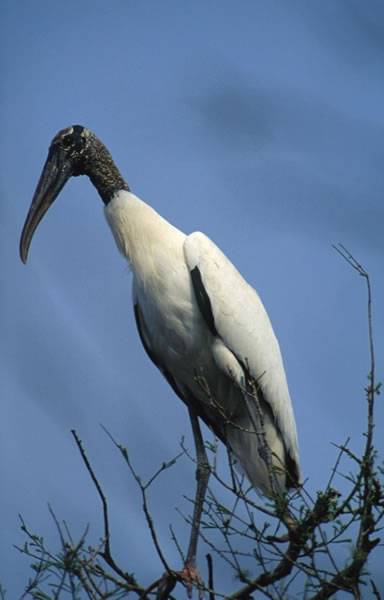
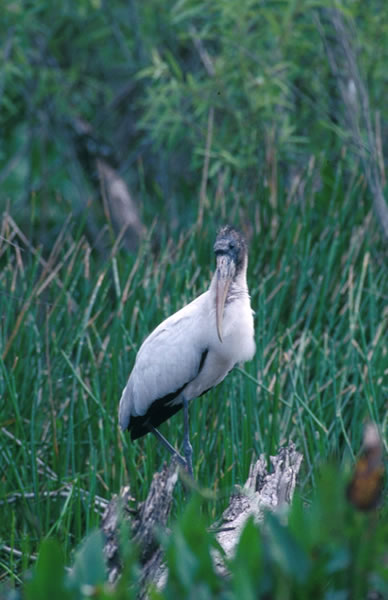
The Wood Stork is the only stork species that regularly breeds in North America. It is a large bird that measures 40–44 inches (101.6–111.8 cm) in length and has a wingspan of about 5 feet (1.5 m).
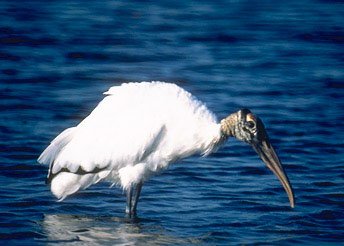
Wood Storks have a bare, gray-to-black head and neck, a white body, and black flight feathers on their wings and tail. They have a long, slightly curved black bill and long legs.
Unlike herons, which fly with their necks folded back, Wood Storks fly with their necks stretched straight out. Males and females look alike.
The wood stork feeds during the day and at night. It eats small fish, frogs, mollusks, snails, insects, and aquatic invertebrates. It hunts for its prey in shallow, muddy-bottomed banks or wetlands. The wood stork moves slowly through the shallow water, its bill open, feeling for movement. When the wood stork locates a fish, it quickly snaps its bill shut.
Life Cycle
Wood stork pairs often mate for life. Pairs often return to the same nesting colony site year after year. The nest is a platform made of sticks and placed in a tree. There may be as many as 25 nests in a single tree! Both the male and the female build the nest. The female lays 2 or 3 white eggs, and both parents take turns incubating them. Incubation takes 28-32 days. Both parents feed and care for the chicks. The chicks fledge (develop flight feathers) in about two months.
Behavior
The wood stork is an excellent flier. It soars thousands of feet in the air with its legs and neck outstretched and rides on air currents. The wood stork sometimes performs rolls and dives in flight.
The wood stork breeds in Florida, Georgia, and South Carolina. After the breeding season, it can be found north to North Carolina and west to Mississippi. The wood stork is also found in the Caribbean and Central and South America.