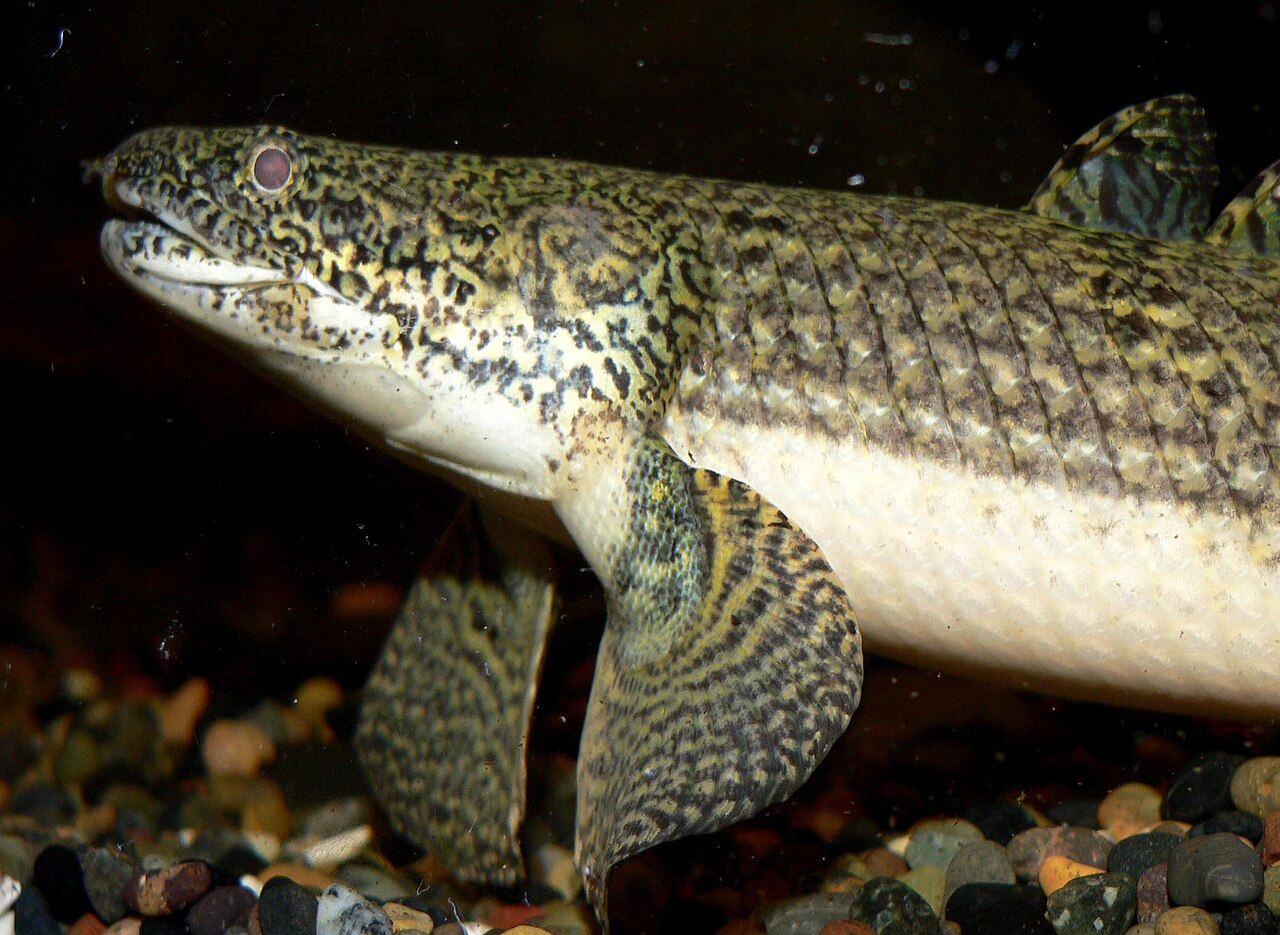
There are 14–16 species of freshwater fish in this order, all belonging to a single family. These fish are often called “living fossils” because they have kept many ancient features that date back millions of years. This group includes two main types: bichirs and reedfish
Polypteriformes live in rivers, swamps, and floodplains across tropical Africa, including parts of the Nile River system. They are especially common in slow-moving or still waters, where oxygen levels can be very low. Luckily, these fish have an amazing adaptation: in addition to gills, they have lung-like organs that let them breathe air. They can gulp air at the surface and even survive out of water for short periods—as long as their skin stays moist.
These fish have long, eel-like bodies covered in thick, diamond-shaped ganoid scales that act like armor. Instead of one long dorsal (top) fin, they have a row of 7–18 small finlets running along their backs. Depending on the species, they can grow anywhere from 10 to 39 inches (25–100 cm) long.
Polypteriformes are carnivores and are mostly active at night. They eat smaller fish, insects, and crustaceans. Even though their eyesight isn’t very strong, they make up for it with an excellent sense of smell. They often move slowly along the bottom, using their fleshy pectoral fins to “walk” in a crawling motion.