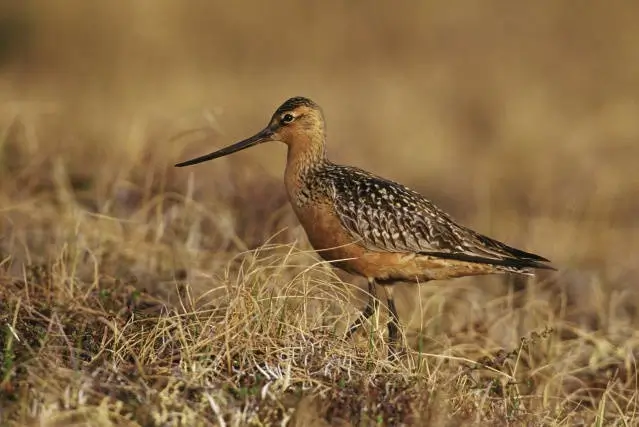
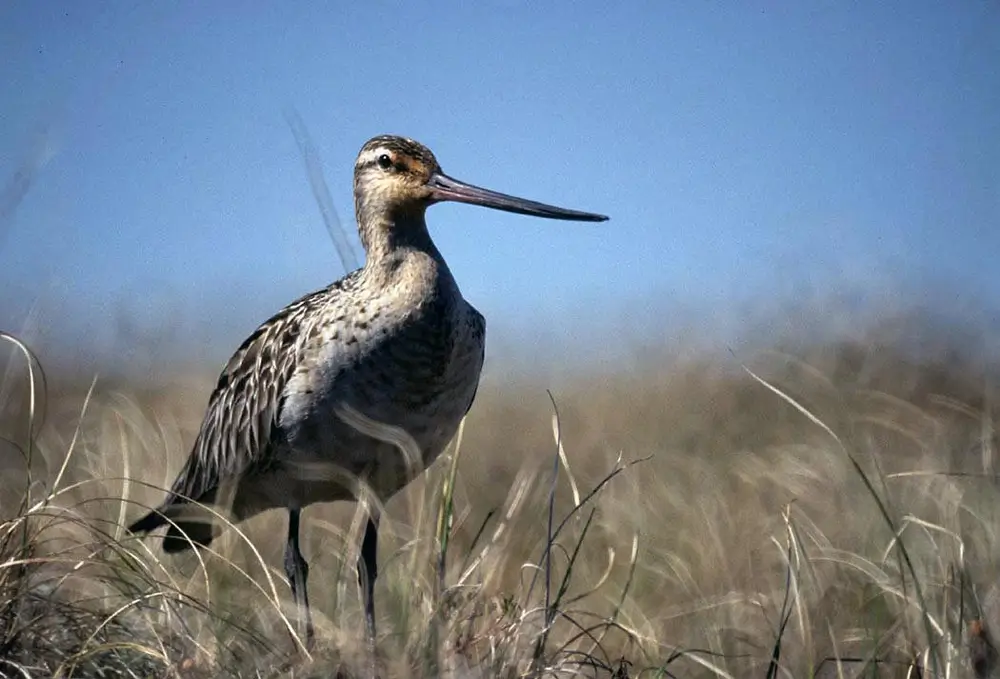
The bar-tailed godwit is 15-18 inches (38.1-45.7 cm) in length with a wingspan of 28-31 inches (71.1-78.7 cm).
In the breeding season, the male has a mottled brown back, long black legs, and a brownish-red breast and head. The female has the same coloring, but it is a little duller. In the winter, it is a mottled grayish-brown.
The bar-tailed godwit has an upturned bill and a white tail with black bars. Males and females are similar in appearance, but the females have a slightly longer bill.
Habitat
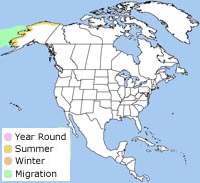
In Alaska, the bar-tailed godwit is found on the tundra in the summer. It prefers tundra areas with hummocks, or low mounds of earth.
The bar-tailed godwit eats insects in the summer. Occasionally, it eats seeds and berries.
In the winter and during migration, it wades in the water, probing in the mud with its long, thin bill for mollusks, crustaceans, snails, worms, and other aquatic invertebrates.
Life Cycle
The female bar-tailed godwit lays four eggs in a depression in the ground lined with lichen, moss, and grass. Males and females incubate the eggs.
The chicks hatch in 20-22 days and leave the nest shortly after hatching. Both parents care for the young until they fledge at 30 days.
The oldest recorded bar-tailed godwit was at least 36 years old.
Behavior
The bar-tailed godwits that breed in Alaska migrate over the Pacific Ocean to the coast of New Zealand and Australia, making a non-stop trip of close to 7,000 miles (11,265.4 km). Scientists think the trip takes about a week. That’s one week of flying, without stopping to rest or eat.
On the return trip to Alaska, the bar-tailed godwits fly to the shores of the Yellow Sea in Korea and stay for a few weeks while they eat and fatten up for the return trip to Alaska.