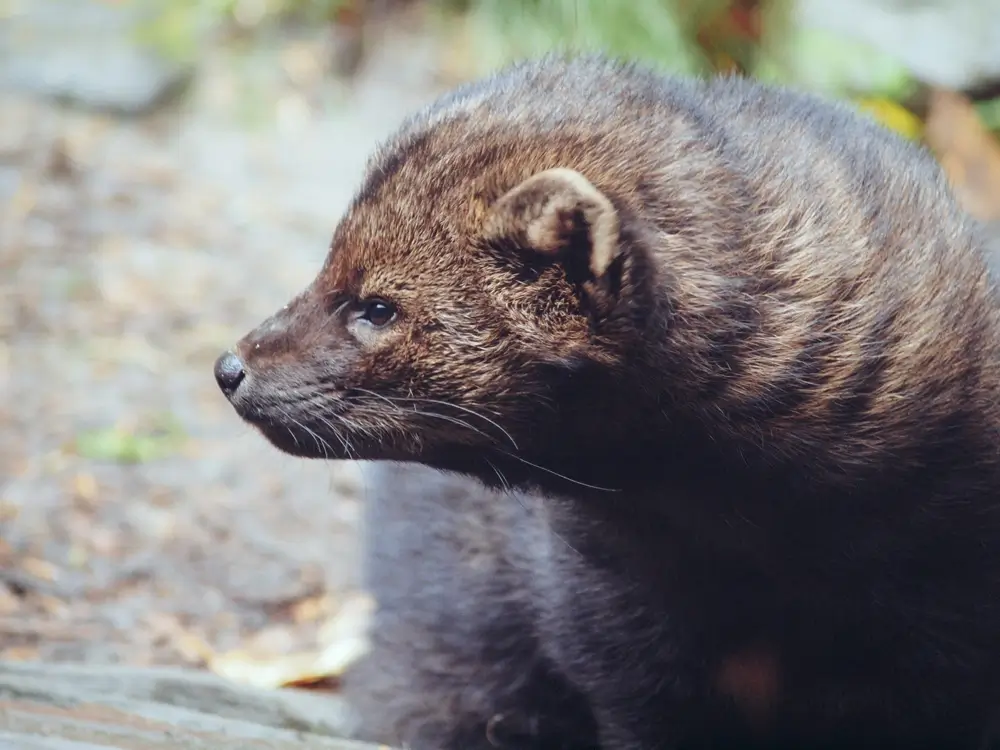
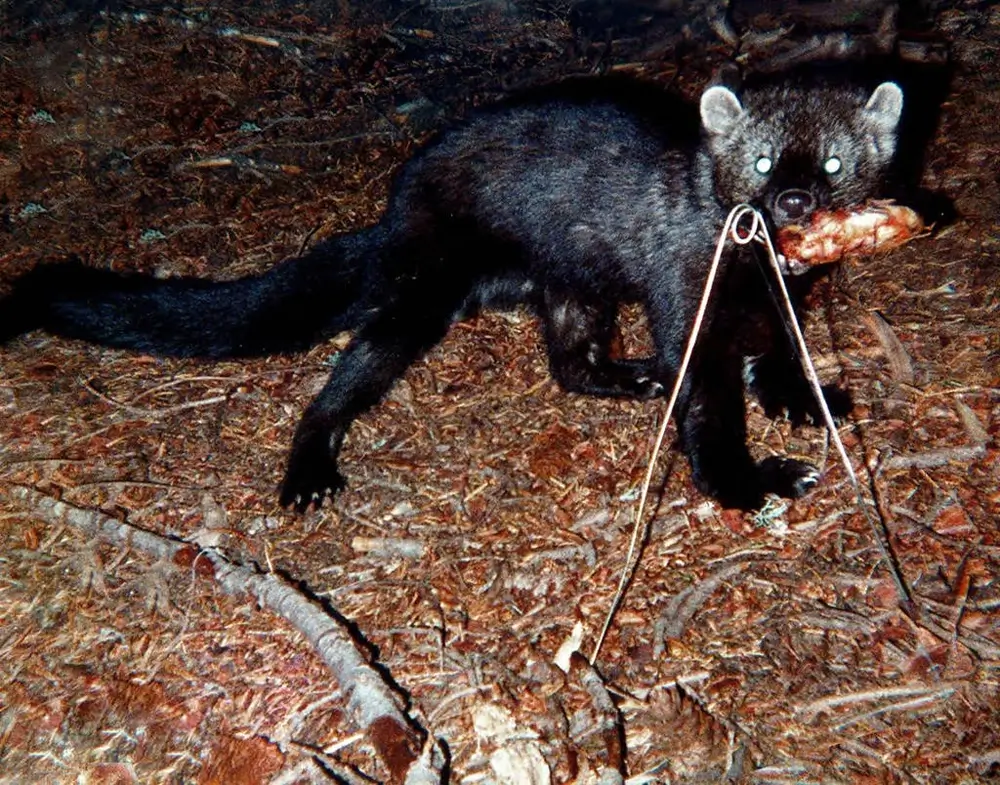
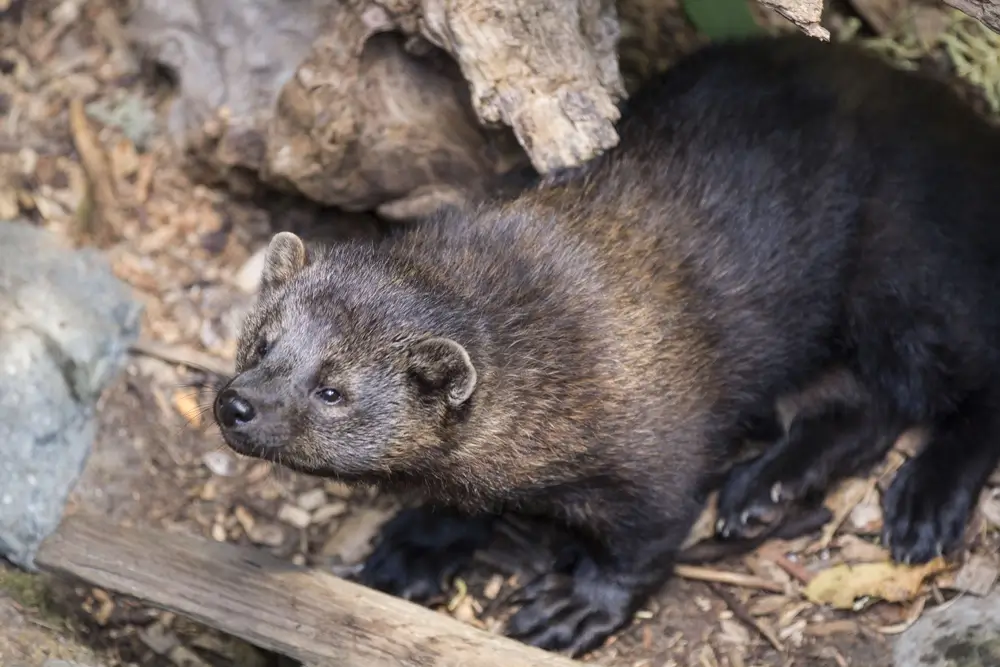
The Fisher has a long body and dark brown to light brown fur. It has long claws on both its hind and front paws. Its front and hind legs are black, and it has a long, thick, black tail. It has a short muzzle and round ears on the sides of its head.
Male Fishers are much larger than females. Males are 2.9-3.9 feet (0.88-1.2 m) long and weigh 8-16 pounds (3.6-7.3 kg). Females are 2.5-3 feet (0.76-0.91 m) long and weigh 4-6 pounds (1.8-2.7 kg).
Habitat
The Fisher lives in thick coniferous or mixed coniferous and hardwood forests. It prefers habitats with lots of tree cover and hollow trees for dens.
When it preys on porcupines, it attacks the porcupine’s face repeatedly until the porcupine is weakened from trying to defend itself. It eats the porcupine’s organs first and saves the rest of the kill to eat over the next couple of days.
Fishers don’t always win battles with porcupines, and they are sometimes badly injured or killed by the porcupine’s quills.
Life Cycle
Fishers mate in March and April. The female gives birth 10-11 months after mating. She has one to six babies in a nest in a hollow tree. Baby Fishers are called kits. The kits are blind at birth. If the nest is disturbed, the female moves her kits to another spot.
In the wild, the lifespan of a Fisher is around 4-8 years.
Behavior
The Fisher is usually nocturnal (active at night). A Fisher’s home range is usually about 10 square miles (25.9 km²) and may overlap with the home ranges of other Fishers. It uses scent to mark its territory.
A Fisher moves around its home range frequently, following well-used trails. It travels both on the ground and through the trees.
The Fisher makes its den in crevices, under bushes, in logs, and in trees. In the winter, it sometimes uses a den in the snow.
The Fisher is an excellent swimmer and climber.
Did You Know?
The Fisher is sometimes called the Fisher Cat, but it is not related to the cat family. It is a member of the weasel family.