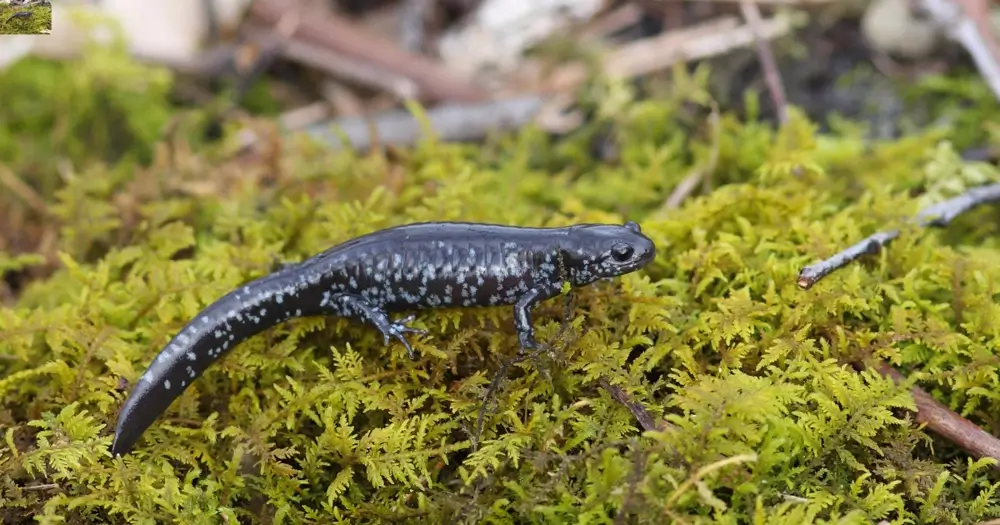
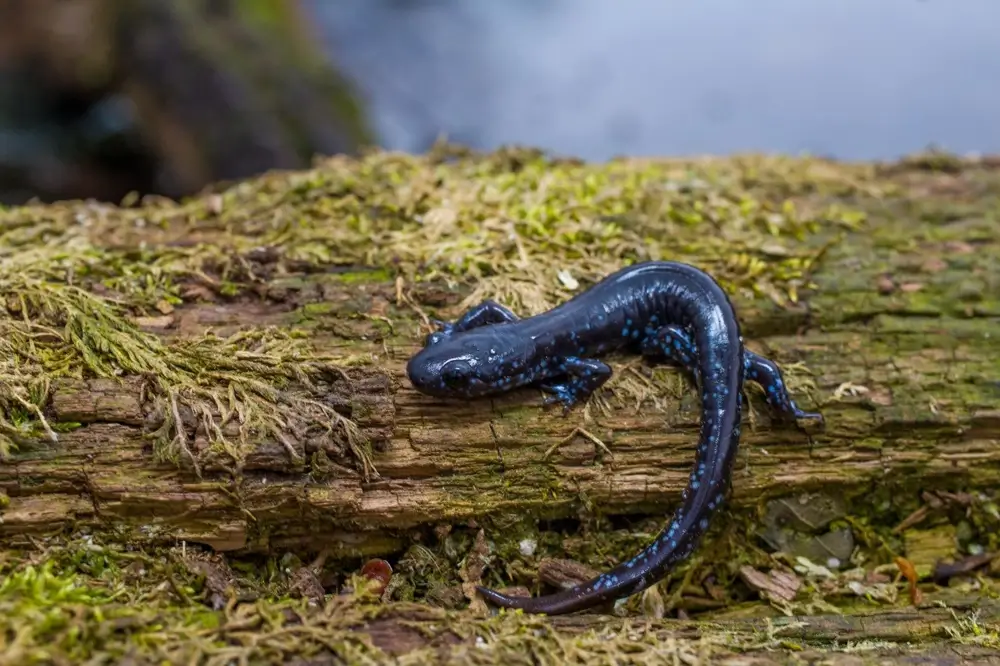
The blue-spotted salamander is a slender salamander, 3-5 inches (7.6-12.7 cm) in length, with a long tail. It is gray to blue-black with blue spots on its sides, tail, and legs. Its belly is lighter than its back. It has four toes on its front feet and five toes on its rear feet, and 12 costal grooves (vertical grooves) on its body. Males are usually smaller than females
Habitat
The blue-spotted salamander lives in deciduous and coniferous forests. It likes places with moist soil and small ponds. It often takes shelter in burrows or under damp leaves, moss, or logs.
In early spring, the blue-spotted salamander migrates to vernal ponds or pools. Males arrive first. Vernal ponds make good breeding grounds. Vernal ponds are temporary ponds that form in the spring when the snow melts. Vernal ponds eventually dry out. This prevents predators that might eat the salamanders, like fish and frogs, from establishing themselves in the pond.
The male grabs onto the female with his front legs and gently rubs his chin on her head. Then, he places a small packet of sperm, called a spermatophore, on the bottom of the pond. After that, he tries to guide the female over it. If everything works, the female takes in the spermatophore, and the sperm fertilizes her eggs.
The female lays her eggs on the bottom of a pond. The eggs stick to plants, rocks, logs, or other debris. After two to four weeks, the eggs hatch into larvae. These larvae have external gills and no legs at first.
As they grow, they develop legs and lose their gills. During this stage, they eat small crustaceans, worms, and insects. The time it takes for them to change from larvae into adult salamanders depends on how much food is available.
Behavior
The blue-spotted salamander is very secretive and spends most of its time underground, only coming out from cover at night and during damp or rainy weather. It has glands on its tail that produce a milky toxin (poisonous substance produced by a living thing) that it secretes when threatened. If a predator attacks, it curls its tail over its body and releases the toxin into the predator’s mouth.
Did You Know?
The blue spots on a blue-spotted salamander’s body help break up its shape, making it harder for predators to see it at night.
Support for NatureWorks is provided by:
The Blue-Spotted Salamander in NH
The blue-spotted salamander is found throughout New Hampshire.
The blue-spotted salamander is found in the eastern central United States and Canada east to the Atlantic provinces in Canada and northern New England and in the Great Lakes region.