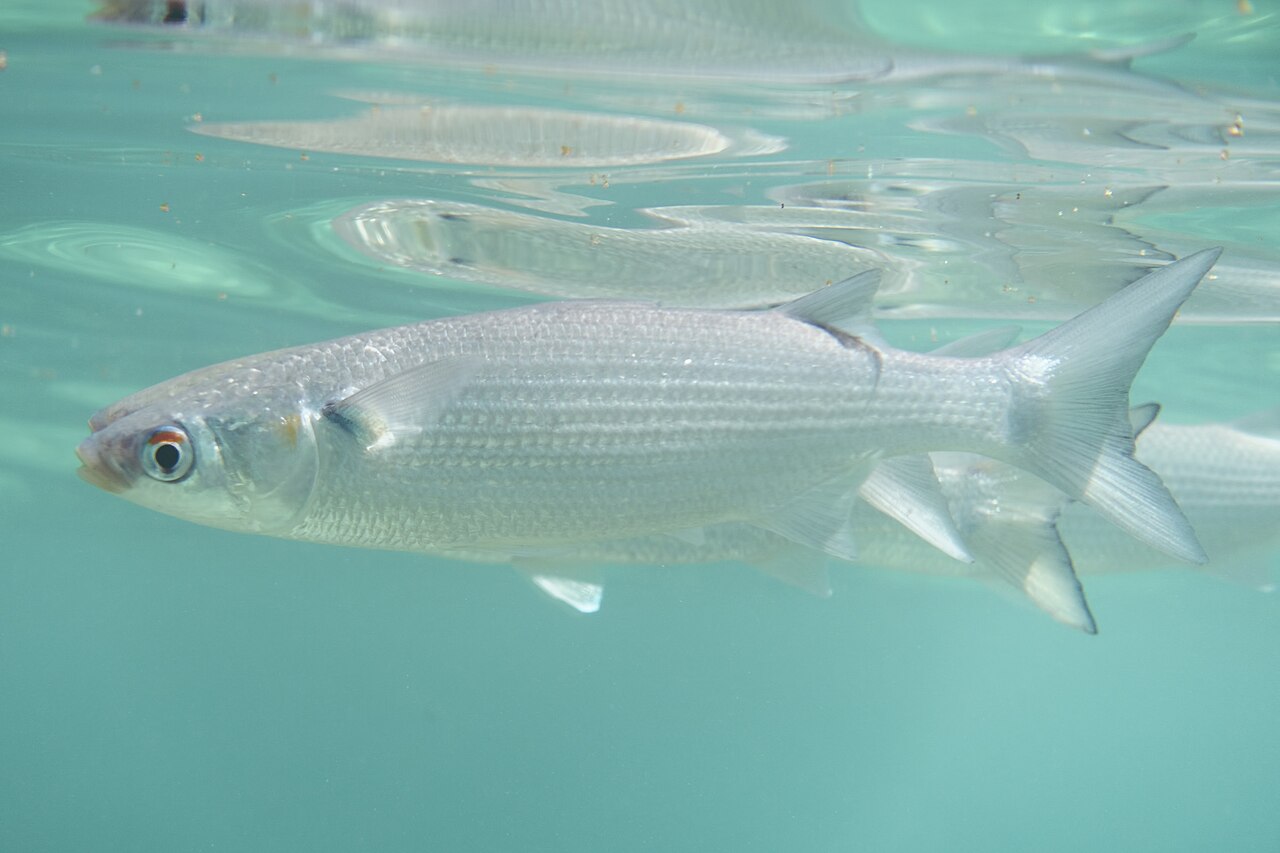
There are about 130 species in this order, grouped into two main families: the Mugilidae (mullets) and the Ambassidae (Asiatic glassfish and perchlets).
Mullets live in warm coastal waters around the world. They can be found in oceans, estuaries (where rivers meet the sea), and sometimes in rivers and lakes. Their ability to live in both saltwater and freshwater environments makes them especially adaptable.
Mullets have long, streamlined bodies that help them swim efficiently through currents. They typically have two separate dorsal (top) fins and a strong, forked tail for quick movement. Most mullets are silvery in color, which acts as camouflage by reflecting light and helping them blend into their surroundings. This makes it harder for predators to spot them.
Unlike many fish that actively hunt other animals, mullets are mostly herbivores or detritivores. Detritivores feed on algae, tiny plants, and organic material (bits of decaying plants and animals) found in sand or mud. They often swim in schools and can be seen “grazing” along the bottom, playing an important role in keeping their ecosystems clean and balanced
Scientists have recently included Asiatic glassfish in this order. These fish are known for their transparent or semi-transparent bodies, which can make their internal organs visible. Asiatic glassfish are found in parts of Asia, Oceania, the Indian Ocean, and the western Pacific Ocean.
These fish live in warm regions, especially in freshwater and brackish (partly salty) habitats such as rivers, estuaries, and coastal lagoons across Asia and Australia. Their clear bodies help them blend into their surroundings, making them harder for predators to see—an important survival advantage.
Asiatic glassfish are usually small, typically only a few inches or centimeters long. They have flat, laterally compressed bodies (meaning thin from side to side), large eyes, and often a slightly silvery or shimmering appearance.
Most members of this family are carnivores, feeding on tiny aquatic animals such as plankton, insect larvae, and small crustaceans.