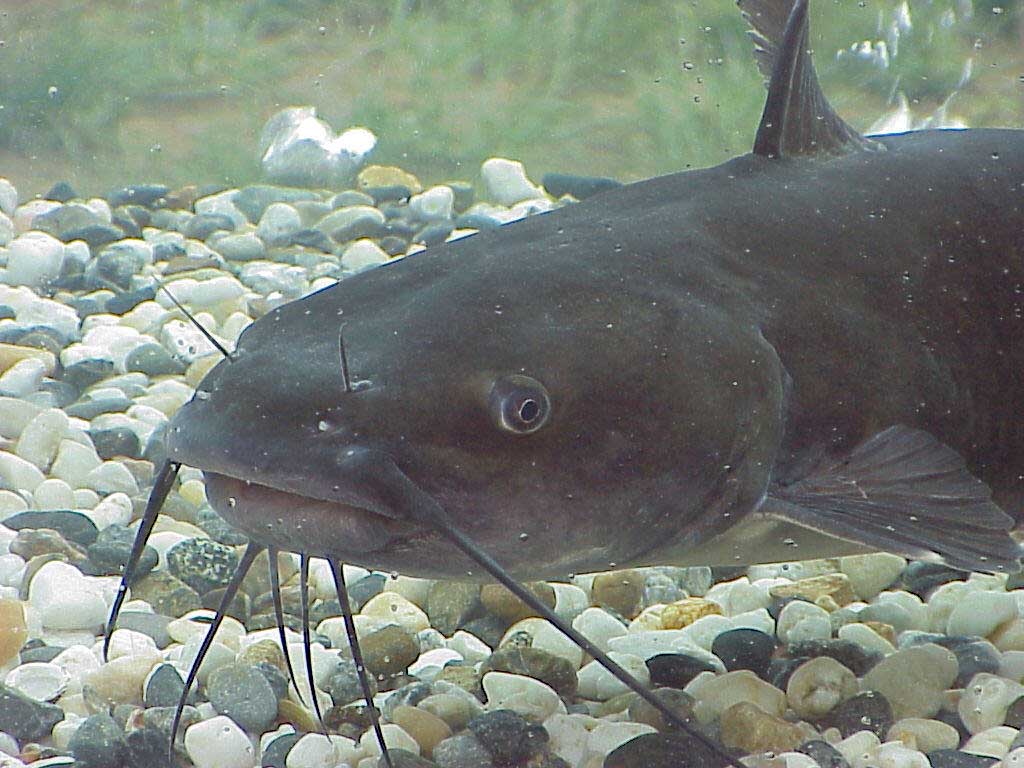
There are close to 4,000 ray-finned fish found in 35-40 families in this order. Catfish are mostly found in freshwater habitats around the world. Some species also live in brackish or marine environments.
Catfish are best known for their distinctive barbels (fleshy filaments growing from the mouth or snout of a fish), which resemble a cat’s whiskers and give the group its common name. These sensory organs are rich in taste buds and help the fish locate food in dark or murky water. Most catfish also have a flattened head, a scaleless body (though some species have bony plates), and strong spines in their dorsal (top) and pectoral (side) fins that can be used for defense.
Some species, like the tiny parasitic candiru, are only 1-3 inches (2.5-8 cm) long, while others, like the Mekong giant catfish, can grow to 9.8 feet (3 m) and weigh up to 770 pounds (350 kg). Many catfish are bottom-dwellers and scavengers, feeding on insects, crustaceans, plant matter, or other fish, though some are active predators.
Catfish species are found on every continent except Antarctica, with the greatest diversity in tropical regions of South America, Africa, and Asia. They occupy a wide range of habitats, including rivers, lakes, swamps, and caves. Some cave-dwelling species have reduced or absent eyesight, relying heavily on their barbels and other sensory adaptations.